
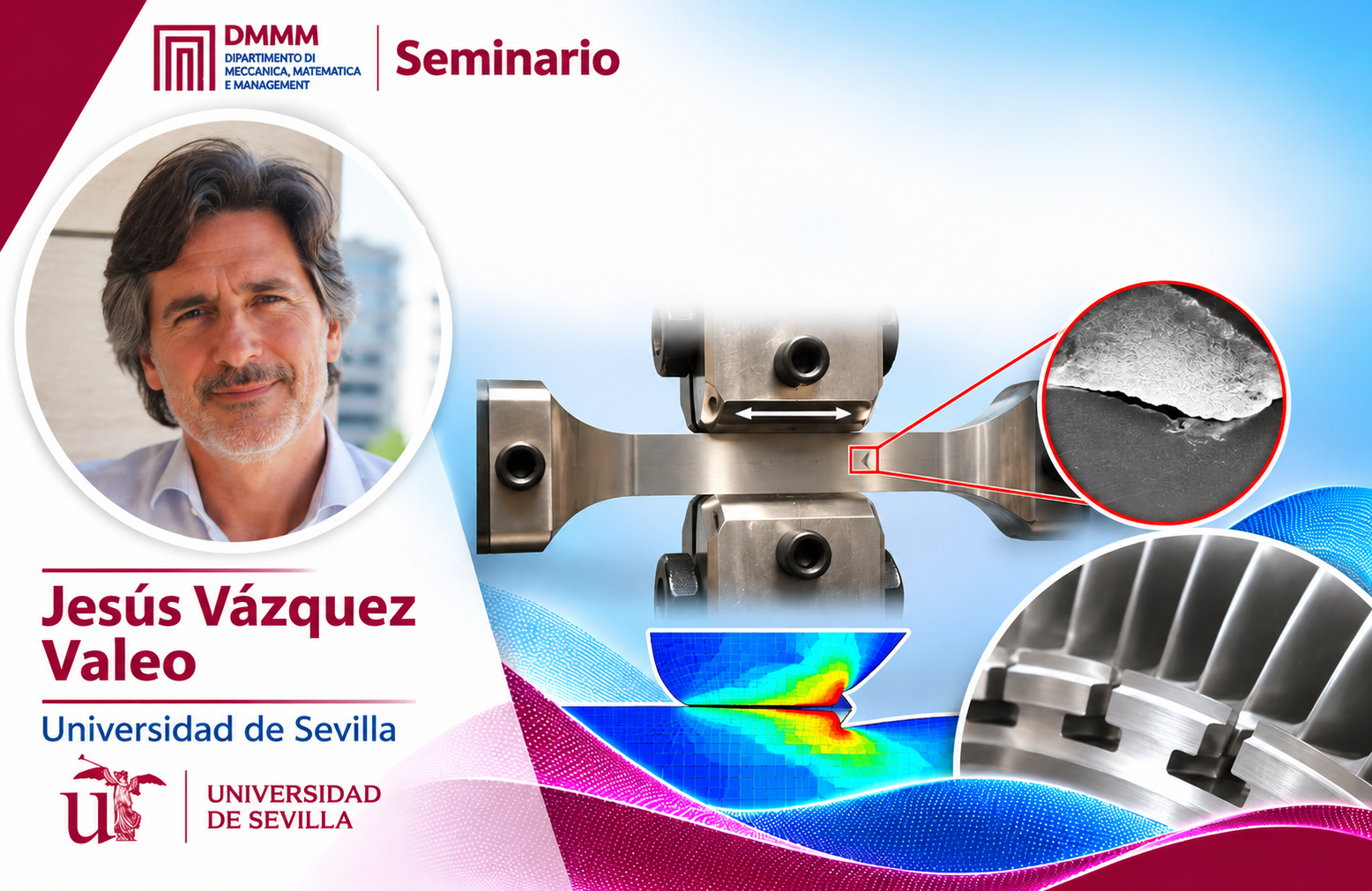
Fretting fatigue: effects, palliatives, testing and modelling
This talk draws on more than two decades of research at the University of Seville to offer a connected account of three aspects of fretting fatigue. The first concerns palliatives: geometric modifications such as relief grooves, knurling, or counter-intuitive subsurface cavities that redistribute contact pressure, alongside surface engineering treatments — most notably shot peening — whose three concurrent effects (compressive residual stresses, material hardening, and induced roughness) are assessed individually. A result that challenges received wisdom emerges: the roughness imprinted by shot peening, normally detrimental in plain
fatigue, proves beneficial under fretting conditions by reducing subsurface stress intensity factors where cracks seek to propagate. The second aspect addresses testing: fretting bridges, clamp fixtures, and dovetail rigs for gas-turbine simulation are reviewed, with a mention of the trade-offs between experimental control, geometrical fidelity, and ease of analysis. The talk then turns to life
prediction. Total fatigue life is conventionally split into crack initiation and propagation phases, separated by a boundary length that is anything but obvious to define — and whose choice dominates the prediction. A non-arbitrary crack initiation length model developed by Seville’s fre ing group is presented, which determines this length by minimizing the predicted total life across all candidate values. Validated against experimental campaigns in Al 7075-T651 and Inconel 718, and extended to handle residual stress relaxation and self-steered crack paths, the model offers a principled route into one of the field's most persistent open problems.